Most marketing leaders I talk with have the same problem, dressed in slightly different clothes. They sit across from me and say something like: "We have all this data. Mountains of it. We know it's valuable. But we don't actually know what to do with it."
They're not asking for more analytics dashboards. They already have those—and are facing analysis paralysis. They're asking for something more fundamental: direction.
The real question isn't "what does our data say?" It's "what should we do next?"
And that's a very different question.
The Gap Between Having Data and Using Data
Here's what I see happening: Organizations invest heavily in data infrastructure. They build robust customer databases, track campaign performance, implement attribution models, and create beautiful visualizations. All good things. All necessary things.
But then they hit a wall. They have insight without action.
Having data about your customers and knowing how to orchestrate your marketing to serve them optimally are two entirely different capabilities. The first is about collection. The second is about translation and activation.
Most organizations are stuck in the middle, with data on one side and marketing execution on the other, and a foggy, uncertain space between them where decisions should happen but often don't.
This is the invisible gap where opportunity lives and dies.
What "Maximizing Marketing Goals" Actually Means
Let's get specific about what we're really trying to solve.
When you say you want to "maximize marketing goals," what you're actually describing is a deeply complex orchestration problem:
- Who should receive which messages?
- When is the optimal moment to reach them?
- What offers will resonate based on their unique context and history?
- How often should you engage them without triggering fatigue?
- Which channels will they actually pay attention to?
- How do you prioritize when you can't do everything for everyone?
This isn't a single decision. It's thousands of interconnected decisions that need to work in concert, informed by data, executed with precision, and continuously refined based on what you learn.
.png)
The technical term for this is "personalization at scale." The human term is: "treating each customer like an individual while serving millions of them." And here at MERGE, we define the opportunity for this reality as infinite individualism™.
This requires more than data. It requires a roadmap. It requires alignment. And it requires many departments working together.
The Hidden Value in What You Already Have
Here's what's fascinating to me: Most organizations already possess the raw materials to achieve infinite individualism. The segments exist in your database. The behavioral signals are captured in your campaign history. The patterns are hiding in plain sight within your existing data.
What's missing isn't more data. It's the connective tissue that turns scattered information into aligned, strategic direction.
This is where segmentation stops being a static marketing exercise and becomes the foundation of an experimentation program. Where data science discovers the hidden trends that your intuition missed. Where all of it synthesizes into a detailed, actionable roadmap that defines your optimal marketing cocktail (or mocktail).
It is not a generic best practice. It’s your cocktail. Built from your data. Aligned with your goals.
From Evaluation to Activation: A Different Kind of Exercise
From our experience, the steps needed to achieve this aren’t a typical analytics initiative. It's an organizational design challenge dressed as a marketing opportunity.
First, you must start by evaluating what you already have:
- Your current data infrastructure and quality
- Your existing segments and how they're being used (or not used)
- Your personas and whether they reflect real behavioral patterns or wishful thinking
- Your current campaign goals and how they align (or conflict) across departments
- Your marketing channel performance and the assumptions baked into how you measure success
But evaluation is just the diagnostic. The real work is in the translation: turning what you discover into your next best action, your next quarter's initiatives, and a roadmap for ongoing, data-driven decision-making that compounds over time.
This means building the bridge between "here's what the data shows" and "here's what we're doing Monday morning."
The Roadmap as a Living Document
A roadmap isn't a static presentation deck that gets shelved after the initial presentation. It's a living instrument that evolves as you learn, as markets shift, and as customer behavior changes.
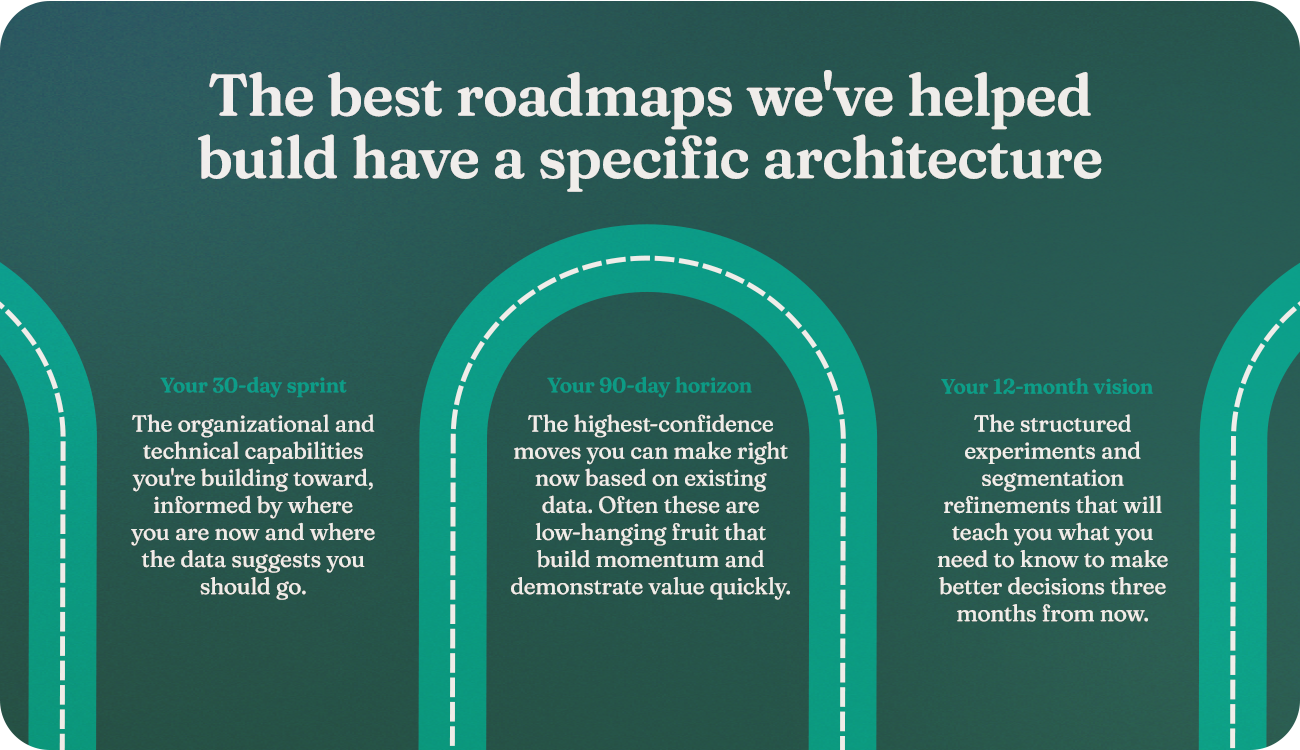
The best roadmaps we've helped build have a specific architecture:
Immediate next actions (your 30-day sprint): The highest-confidence moves you can make right now based on existing data. Often these are low-hanging fruit that build momentum and demonstrate value quickly. This is where internal momentum begins.
Next quarter initiatives (your 90-day horizon): The structured experiments and segmentation refinements that will teach you what you need to know to make better decisions three months from now. This is where experimentation programs get designed and launched.
Long-term strategic direction (your 12-month vision): The organizational and technical capabilities you're building toward, informed by where you are now and where the data suggests you should go. This is where predictive modeling and advanced personalization become possible.
Each layer informs the next. Each builds on what came before. And critically, each is designed to be fine-tuned based on what you learn along the way.
What Makes This Different
This isn't about your team "running some analysis" and delivering a report. It's about collaborative discovery that transforms how your organization thinks about and acts on its own data.
The outputs aren't just insights. They're:
- Prioritized offer strategies based on personalized signals
- Frequency and channel recommendations grounded in actual behavior patterns
- Segmentation architectures designed for ongoing experimentation
- Data science frameworks that surface hidden trends automatically
- Decision-making protocols that make your team faster and more confident
All of it rolls up into a roadmap that doesn't just tell you what to do, but why you're doing it, how to measure whether it's working, and what to do next, based on what you learn.
The Real Transformation
What I've learned over years of doing this work is that the ultimate breakthrough isn't technical. It's cultural.
When an organization finally sees the path from its data to its next marketing action clearly, something shifts. Marketing teams stop guessing. Analytics teams stop feeling disconnected from business impact. Leadership starts making decisions faster because they trust the foundation beneath them. And oh yeah, the constant battle for budget disappears as every action measures attributable value toward business goals.
The data doesn't change. The technology doesn't fundamentally change. What changes is the organizational architecture that turns information into coordinated action.
And that's when marketing goals stop being aspirational and start being inevitable.
Where to Begin
If you're sitting on data you know is valuable but uncertain how to translate it into marketing momentum, the first step isn't collecting more data. It's creating the clarity that lets you act on what you already have.
Let's evaluate where you are, understand what you're trying to achieve, and build the roadmap that connects the two.
Because somewhere in your existing data, segments, personas, and campaign history, your next best action is waiting to be discovered.
Let's connect.


