Imagine buying 50,000 tons of steel, 100,000 bags of concrete, and miles of copper wiring. Then you dump it all on an empty lot and tell your crew: "Start putting it together, and eventually we’ll get a skyscraper."
Sounds silly, right? No general contractor operates this way. But this is precisely how most orgs approach their data strategy.
Every year, pharmaceutical manufacturers, health systems, and medtech leaders pour tens of millions into building massive enterprise data lakes, stitching together EHR feeds, and incorporating real-world evidence (RWE). They do this under a long-standing belief: if you aggregate enough data, actionable business transformation will naturally follow.
It may sound disciplined on paper but in practice, it leads to technology logjams, massive integration backlogs, and massive time wasted to the point where people forget about the initial promise of all that data in the first place.
The shift to a decision-first mindset
Here’s an interesting stat: 62% of executive leaders admit poor data quality undermines their decision confidence, yet organizations that explicitly compete on decision velocity are 3× more likely to achieve top-quartile financial performance.
The problem has never been lack of data; it's that we are trying to dredge an entire ocean to find a single dropped key. The answer isn't to build a bigger net. We need to shift from a data-first to a decision-first mindset. That’s where traditional approaches begin to break down.
Conventional data consulting builds from the bottom up:
- Audit existing data sources and legacy infrastructure.
- Build expansive, multi-year pipeline architecture.
- Hope strategic business insights magically materialize at the top.
In life sciences, this approach slams into a momentum-halting brick wall almost immediately. The sheer scale and complexity of clinical data, claims records, payer formularies, and patient sentiment create an endless maze of compliance hurdles and technical friction. If you start with life sciences data, you'll never get out of the maze.
You don't end up with actionable intelligence. You end up with strategy-rich, infrastructure-poor initiatives or, at best, data-rich, insight-poor repositories where millions of dollars sit trapped in digital silos.
A life sciences reality check: The oncology launch
Consider a classic commercial scenario in specialized oncology.
A pharmaceutical enterprise is preparing to launch a new indication. Under the traditional data-first model, the enterprise spends 18 months attempting to build a unified "360-degree customer engine." They attempt to integrate specialty pharmacy dispensation feeds, medical claims, lab results, CRM logs, and digital engagement analytics across hundreds of hospital networks.
Two years and millions of dollars later, the launch team is still waiting for IT to resolve duplicate physician IDs and integrate ICD-10 codes. Meanwhile, the commercial window is closing, and competitors are capturing market share.
Now, look at the same launch through an inverted lens.
Instead of trying to unify every piece of data touching every provider, you start with the single, high-stakes commercial decision:
"Which trialists have the require patient populations and historic digital and field force touch point volume to act as the core growth engine of our new indication beyond our brand loyalists?"
When you frame the problem around that precise decision, 80% of the data engineering work vanishes overnight.
You don't need a fully unified enterprise data lake to answer that question on Day 1. You only need to isolate three specific input signals: targeted diagnostic lab triggers, recent formulary coverage shifts, and rep engagement history.
By targeting the decision first, you cut launch execution time from years to weeks.
The inverted architecture: Decision-back strategy vs. data-first
To escape the data-first trap, life sciences organizations must flip the stack. Instead of building pipelines toward an unknown future, you work backward from executive intent.
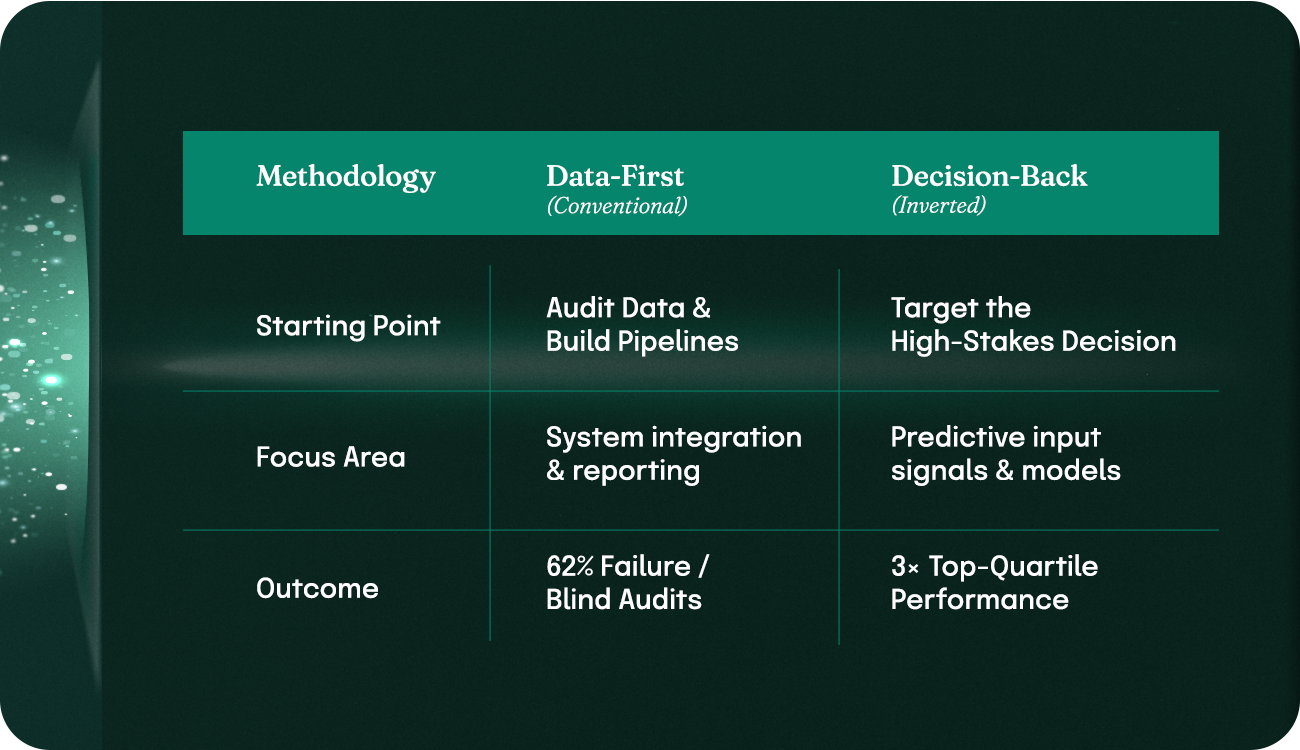
Our framework executes this inversion through four distinct operational pillars:
- Frame (The Decision Inventory): Identify the high-stakes commercial, clinical, or operational choices leadership needs to make. Whether it’s launch resource allocation, payer reimbursement strategy, or patient adherence intervention, you build an executive inventory prioritized by financial and strategic impact.
- Isolate (The Input Signal Map): Strip away the noise. Work backward from the target decision to isolate the exact predictive signals, behavioral variables, and mathematical models required to make that call with high confidence.
- Architect (The Sequenced Workplan): Build and instrument data pipelines exclusively for those required inputs. Stop building infrastructure for data you might use next year; engineer pipes strictly for the decisions you must make today.
- Validate (Defensible Business ROI): Measure whether the decision actually moved key business metrics—such as therapy adoption, patient retention, or net margin contribution—establishing a clear, defensible business case.
Overcoming the healthcare governance wall
The reason the inverted model is particularly critical in healthcare and life sciences comes down to organizational culture and regulatory friction. Healthcare carries heavy structural baggage:
- Clinical skepticism: Physicians and clinical leads are rightly skeptical of commercial teams tinkering with sensitive patient data.
- Compliance paralysis: Legal and privacy teams understandably block broad, unmonitored data consolidation efforts.
- HiPPO culture: High-stakes calls are routinely made based on executive "gut feel" (Highest Paid Person's Opinion) rather than objective evidence because existing data tools are too slow or complex to use in real-time.
When you tell a healthcare compliance officer, "We want to aggregate all patient and provider data into a central data warehouse," they see catastrophic risk and immediately slam the brakes.
When you tell them, "We need to access these two specific, anonymized signal feeds to automate a single patient-adherence alert," the conversation changes completely.
The inverted model transforms data governance from a compliance roadblock into a strategic enabler. It reduces risk exposure by keeping data access surgically focused, lowering regulatory friction while accelerating time-to-value.
From vision to velocity
Getting to true decision velocity isn't a three-year IT transformation project. It's an operational choice.
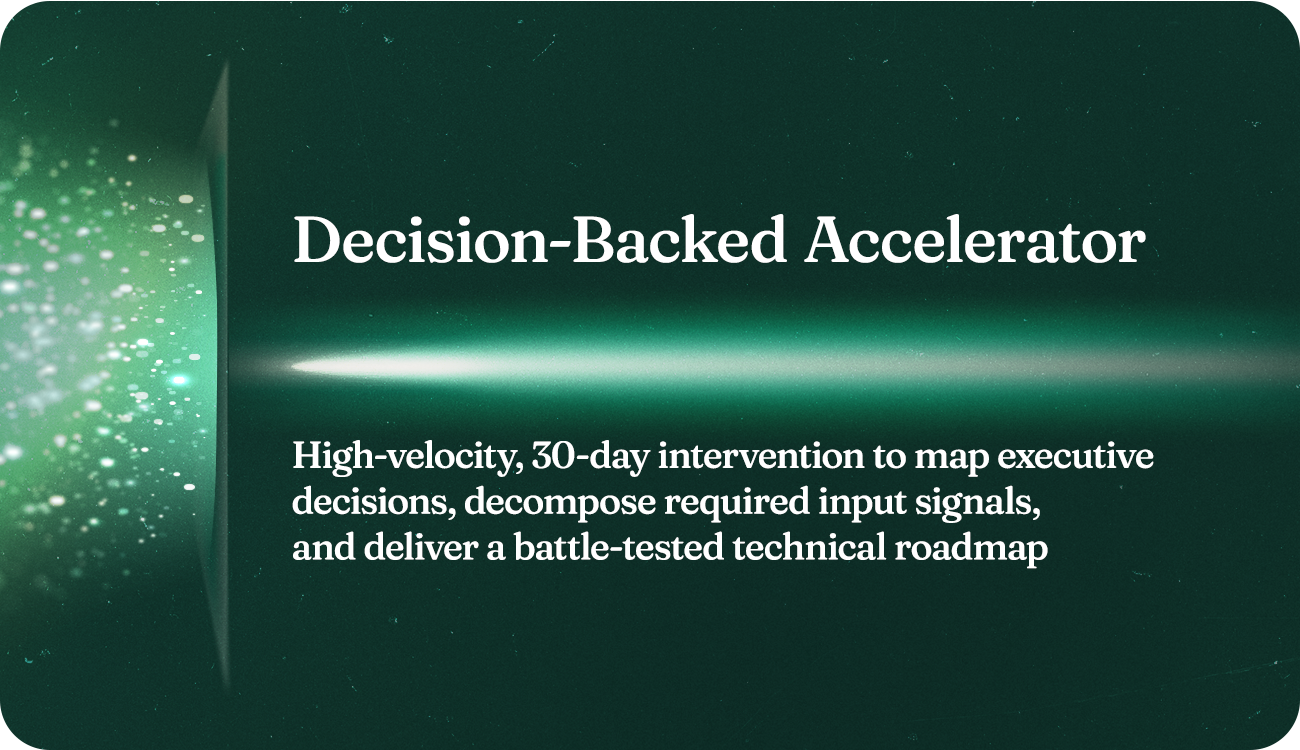
We built the Decision-Backed Accelerator (DBA) to make this shift immediate. It’s a high-velocity, 30-day intervention designed to map executive decisions, isolate required input signals, and deliver a battle-tested technical roadmap.
The vision of AI-driven, highly personalized healthcare experiences is right. But the execution sequence is backward. Stop auditing pipelines you don't need, and start architecting the decisions that actually drive growth.
Let’s connect
If you're ready to bypass governance paralysis and bring immediate decision velocity to your organization, let’s talk. Reach out to explore how a Decision-Backed Accelerator can reshape your commercial roadmap.


