There is a sentence I have heard in every analytics role I have ever held. It repeats with such precision that I can usually predict it before the person even says it.
“We have a lot of reporting but no insight.”
After hearing this for nearly two decades in data, I have spent a great deal of time studying it. I have been the practitioner sitting in the old Omniture interface hunting for patterns. I have combed through ExactTarget email rows hoping something would reveal itself. Every so often I found something interesting, but almost never something transformative.
Eventually I realized a truth that has shaped my philosophy: Insight is not found. Insight is engineered.
High performing organizations do not wait for insight to appear. They design the conditions for insight to exist. They invest in the right structure, the right behaviors, the right data design, and the right collaboration model.
Over time I have found that there are four facets of engineering insight.
- Curiosity.
- Context.
- Comparison.
- Dimensionality.
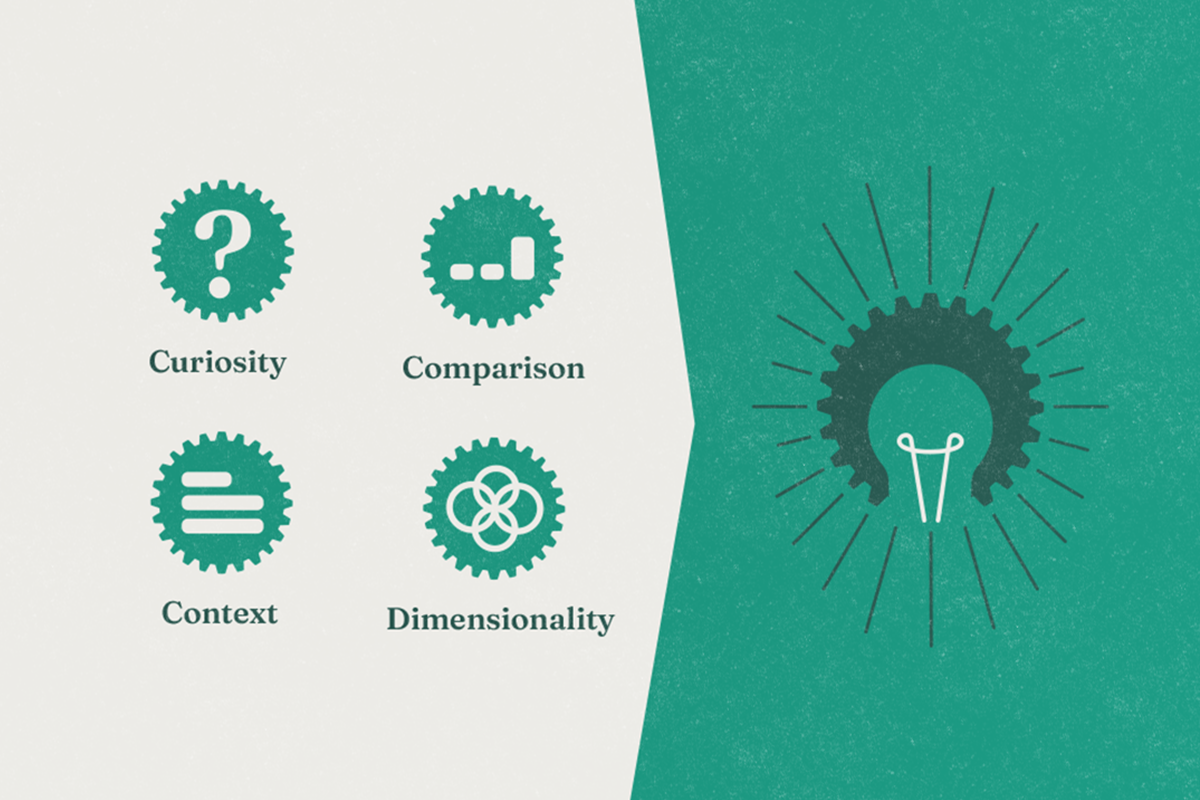
I have brought this philosophy to MERGE as the leader of our Integrated Outcomes team. And, these four pillars sit at the core of our operating model. They also mirror what we know to be true in CRM, personalization, and modern media. They define what separates reporting from real intelligence.
We call ourselves Integrated Outcomes because outcomes, not impressions, are the point. Our team blends channel agnostic performance and the science of decision- making into one connected engine. By integrating every discipline around a shared goal, we help brands move from information to insight to impact: healthier, happier lives.
Curiosity
Curiosity is the single most important trait I look for when hiring analysts and strategists. Curiosity expands a person’s world. It drives a willingness to learn new methods, experiment with AI coding, dive deeper into algorithms, explore visualization science, and push beyond what they already know.
Curiosity also shapes the work itself. Anyone who has worked in analytics knows the feeling of following a thread that seemed promising only to discover it leads nowhere. Good analysts recognize when to walk away and when to dig further. Curiosity creates both the patience and the persistence that insight requires.
Context
One of the most important lessons I learned when I stepped more deeply into the paid media world was this: insight is always collaborative. Analysts working in isolation never have the full story. They cannot know why an optimization was made, why a creative was rotated, or what constraints informed a decision.
This is why our Integrated Outcomes model intentionally blurs the boundaries between media and data practitioners. Context travels through real time collaboration between strategists, analysts, channel practitioners, creative partners, and measurement leads.
Context also extends beyond the media plan itself. It includes macroeconomic shifts, political dynamics, regulatory movements, cultural momentum, and competitive actions. In healthcare this is magnified. A single policy change can alter the velocity of a therapy, reshape demand dynamics, or redefine which audiences matter most.
Without context you have numbers, not insight. Context gives numbers meaning.
Comparison
Comparison is the strongest engine for organizational learning. It shows up most powerfully in structured experimentation. Without experimentation you collect surface level observations that may be interesting but rarely move the business forward.
Every experiment should exist within a learning plan and should serve a purpose. It should advance the organization’s understanding of customer behavior. It should sharpen targeting, shape creative, refine journeys, or reveal new value.
Experimentation has a cost. There is a cost to creating a challenger campaign. A cost to building new creative and passing Media Legal review or MLR. A cost to running a holdout or control to measure the baseline. But the cost of not experimenting is far greater. An organization that is not evolving is declining, even if the numbers look stable for a moment.
Comparison gives us clarity. It is how we make decisions with confidence rather than with instinct or preference.
Dimensionality
Dimensionality is the most complex and the most important facet of insight. It recognizes that audiences are never one-dimensional. A persona is not enough. A list is not enough. Demographics alone are not enough.
To engineer insight you must understand people across many dimensions. Psychographics. Behavioral tendencies. Temporal patterns. Motivations. Barriers. Prior and future actions. In CRM and personalization this is foundational. The more dimensional your understanding, the more relevant your creative, the more accurate your targeting, and the more precise your orchestration.
Each patient and each customer is an individual. There is an infinite uniqueness to how people behave, engage, and decide. At MERGE, we call marketing to these dimensions infinite individualism.
Dimensionality allows us to meet people where they are in context rather than where our dashboards assume they are.
A Realistic View of AI
Although I intended this piece to not be about AI, it is impossible to discuss the future of insight without acknowledging how AI changes the work.
For the foreseeable future, AI is a human enabler more than it is a human replacer. There is no excuse today not to become an expert in whatever you want to learn. AI can research faster than we can.
It can organize and pivot data instantly. It can act as a QA sentinel to ensure data accuracy. It can pressure test hypotheses before we write a line of code. It can help us code models, build prototypes, and accelerate workflows that used to take days.
In Integrated Outcomes we think of AI as force amplification. It does not remove the need for curiosity, context, comparison, or dimensionality. It strengthens them. AI accelerates the engineering of insight, but people still define the questions, choose the comparisons, interpret the outcomes, and connect insights to action.
AI elevates our uniquely human abilities.
The Shift from Reporting to Insight
The next time you read a media report or a clickstream analysis and find yourself thinking that it is simply reporting, ask a different question.
- What have you done to engineer insight?
- Did you foster curiosity?
- Did you gather the right context?
- Did you create comparisons that reveal truth?
- Did you pursue dimensionality that honors the complexity of whole humans?
Insight is not an artifact or a slide. It is the product of an engineered system.
This belief is shaping everything we are building inside Integrated Outcomes, and it’s how we create teams that learn faster, act faster, and drive performance with intention.
Reporting tells you what happened.
Insight tells you what matters.
And engineering insight is how you change outcomes.