We’ve all heard the notion around AI creating negative environmental and sustainability impact. And then we are left wondering, fearfully…so, is it?
AI is moving from experimental to foundational, bringing new complexities for leaders. Because every message about AI feels existential and loud, complex topics are being flattened into what feels binary.
It’s time to move AI discussions beyond the false choice of innovation or integrity.
The hurdle many leaders face right now is not debating the inevitability of AI in their work, it’s determining how to engage with AI across their enterprise strategy. The challenge is accelerating integration without compromising company values; moving forward with AI while being good humans.
No part of a system exists in isolation. Making decisions without understanding the full landscape at an appropriate depth is an exercise in anxiety instead of impact.
Our goal remains the same whether we’re managing energy consumption or eliminating AI bias: to align what we can actually do with organizational impact.
- The control point for environmental impacts of technology sits with the data centers and the exponential power users of that compute power, not with the individual users of the tools.
- Though AI expansion is a driver for raising these issues to popular awareness, the issues surrounding data centers have been growing for decades across the advent of the internet, cloud computing, mobile technology, and all prior technology waves.
- Understanding the issues is a far better way to be proactive in directing your energy than reacting to surface-level information that slows down or limits your AI adoption. AI is inevitable, and ignoring that–even in the name of a virtuous cause–will ultimately be harmful to both your business and the environment.
- While there is a lot of talk about the negative sustainability impacts of AI, any fair assessment needs to also account for the positive impacts. AI directly applied to data centers is improving cooling costs by 40% and aiding in climate risk prediction, and the impacts of AI usage is only limited by imagination. One example alone is AI mapping iceberg changes 10,000 times faster than humans could.
- There are many ways individuals, and certainly business leaders, can address their concerns for the environment and sustainability with far more impact. This includes transportation for your employees, plastic usage or other supply choices in your products and offices, and green building and facilities management.
AI is a paradigm shift that requires new mental models, including how we measure success. It’s no longer measured only by ROI but by how well AI reflects the values of the company using it.
Understanding the landscape
If you’ve ever sat in a quiet room with a high-powered server, you know that sound. It’s the constant, low-grade hum of processing, and it’s always there. In a sense, AI has become the environmental lightning rod of the moment, absorbing all the heat while that noise continues in the background.
Data centers emerged 80 years ago as a centralized place where the power of computing became infrastructure. Data centers have digital demands that are run on physical hardware and traditional fuel sources like electricity and water for cooling. The costs and impacts of data centers have moved from being privately held by individual companies for their own technology needs to, increasingly, centrally held as cloud providers and hyperscaler businesses evolved.
While AI is creating a catalyst moment for exponential demand, the issues are far from new. They’re also largely not something that can be materially impacted on the client side or, in other words, by the users of these technology services. No pragmatic thinker will suggest we stop using technology entirely.
Short of abandoning the internet entirely—no Google searches, no e-commerce, no Wi-Fi in our buildings—digital infrastructure is not optional in modern business. The more useful question is how we participate in these systems responsibly and direct our attention toward the places where meaningful impact can occur.
Focus on the system, not just the query
We must be clear about where the impact lies. The concern isn’t per-query emissions but infrastructure and the power users of the systems. The community-level impacts of data centers are real: water consumption, rising electricity prices, land use, and strain on local resources.
The data center, massive LLM platforms, and AI creation companies are the players who hold the responsibility to balance the good created by technology evolution with the costs to the environment.
If environmental impact and sustainability are important to you and your business–and I hope they are–then I suggest focusing where you can have the most impact. Rather than over-rotating concern to your tech usage, consider your operational, cultural, and structural opportunities. Our daily corporate decisions, from how we commute to how we manage waste, account for a massive share of environmental harm.
Choosing sustainable operations is more than a corporate mandate. It’s a commitment to the health, wellness, and happiness of the communities we serve. It’s about making sure that as we move from experimental to foundational, we don't lose our soul in the process.
Leadership means reclaiming agency where it matters most
Many CEOs have far more immediate influence over environmental outcomes through decisions already within their control, decisions they may have been ignoring. It’s crucial for leaders to direct energy where it actually counts.
Direct Agency: In-house processes and policies can drive results today, reducing emissions faster than avoiding AI tools. This includes:
- Re-examining hybrid work policies, energy procurement, and office footprints
- Changing commuting expectations and offering transportation subsidies
- Evaluating plastic usage, snack room choices, and food supply chains
- Making green facility and building decisions
Indirect Influence: While the footprint of the cloud largely rests with hyperscalers, leaders exert collective influence. We do this through:
- Asking vendors about energy sourcing and infrastructure commitments
- Favoring partners investing in efficiency and transparency
- Participating in industry coalitions shaping standards and accountability
- Designing internal AI usage thoughtfully, avoiding wasteful or redundant deployment
Many of these technology firms are working directly with governments on environmental impacts. Very recently as one example, they’ve confirmed they will carry the increased energy costs. Choose to work with firms that are intentional about how they design and distribute their data center infrastructure, including whether to build a higher number of smaller or midsized facilities versus concentrating capacity in fewer massive sites. The same is true of companies building specialized, lower-resource-demand LLMs instead of massive LLM platforms.
These are not symbolic gestures. They are real-time, measurable levers that shape industry standards over time. Think about your technology choices as voting with your usage, rather than direct environmental impact. They will improve outcomes for the whole human and planet simultaneously.
The risk of restraint
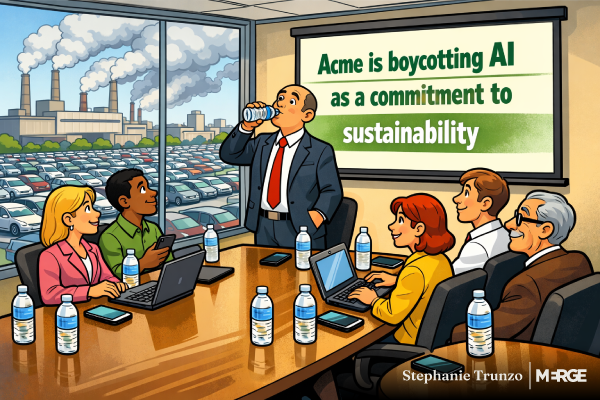
There is a growing temptation to frame AI restraint as a sustainability strategy. It’s not. Avoiding AI adoption does little to meaningfully reduce the global environmental footprint. Instead, it simply ensures your organization is left behind.
The climate impact of restraint is symbolic, yet the business impact is material. This approach puts your competitiveness and workforce resilience at risk. It impedes innovation, even the kind of innovation that can create positive environmental impact.
AI is becoming foundational to productivity, decision-making, and innovation regardless of industry. Companies that fail to engage responsibly will lose their competitive edge and their ability to attract top talent. Spinning more people into the job market because your business is failing to thrive in the new economy is not a sound strategy to save our planet.
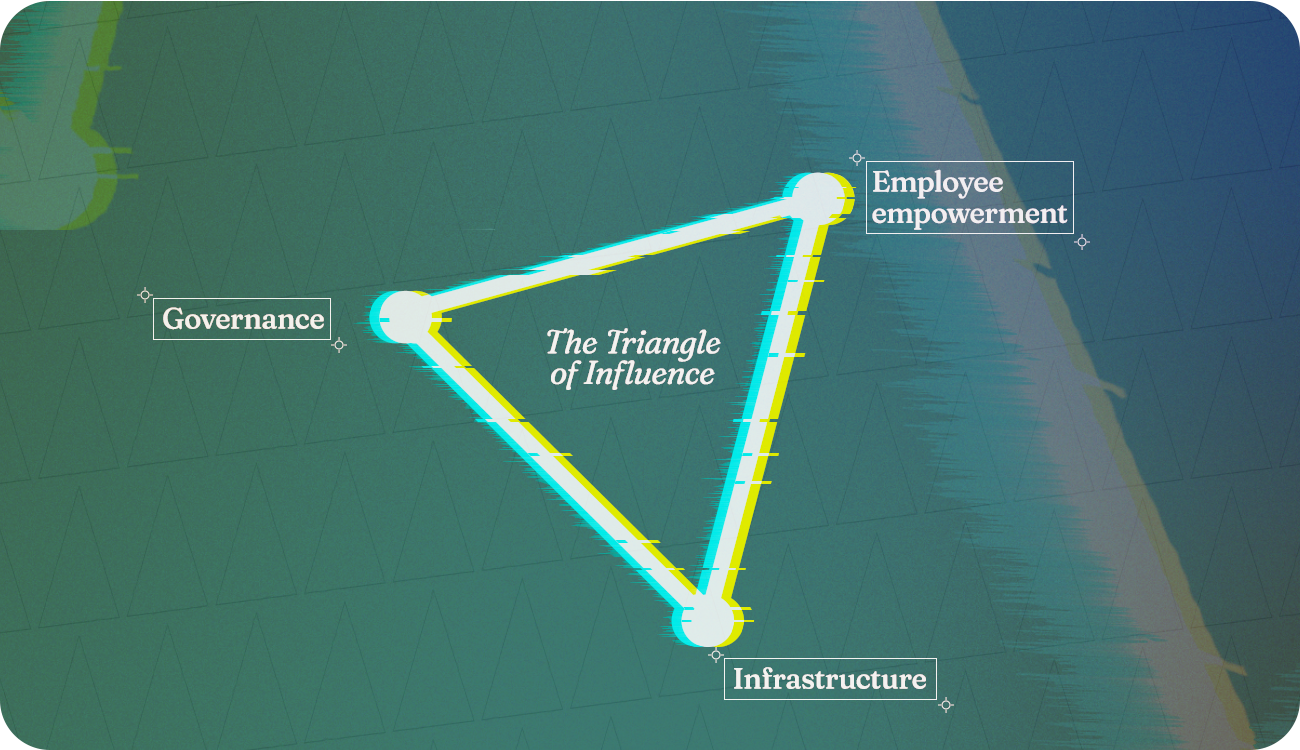
The MERGE Model: The Triangle of Influence
At MERGE, we’re becoming an AIgency, embedding AI into our foundation and treating it as a co-architect and valuable team member. We know that by encouraging our teams to use AI in their daily work, we have a moral responsibility to manage its impact through a Triangle of Influence:
- Employee empowerment: Equipping teams with prompting best practices and teaching them to ask smarter questions so we don’t waste energy on noisy answers
- Infrastructure: Vetting vendors with rigor and using procurement power to reward transparency
- Governance: Building frameworks for responsible AI investment that prioritizes projects based on both business value and estimated carbon footprint
Leadership clarity in a complex moment
AI sustainability deserves scrutiny; but, more than that, it deserves context. The environmental challenges we face are interconnected, systemic, and deeply entrenched.
Real stewardship isn’t about choosing between progress and responsibility. It’s about having the discipline and focus to do both, grounding our innovation in reality and directing our energy where it creates the most good.
AI sustainability is a systems-level challenge. And systems are shaped by those who engage them. Standing still doesn’t reduce impact; it simply forfeits influence.
The leaders and companies who define this era are not the ones who step back and manage the hum. They’re the ones who step in and tune the system.
.png?h=800&iar=0&w=1200&hash=97B84F9CCC4F77AF01F82BC0776D3B33)