Every few years, retail technology makes a promise: “This will change everything.” Most of the time, it changes some things, costs more than expected, and sits alongside everything else you're already running.
Agentic AI is different. Not because the technology itself is magic, but because it fundamentally changes what gets decided by humans versus what gets delegated to systems that can reason, act, and learn.
If you attended the
NRF Big Show 2026, you didn't just see the demos. You saw Google draw a line in the sand with their Universal Commerce Protocol (UCP) announcement. This means:
- AI agents managing inventory replenishment
- AI agents handling customer service escalations
- AI agents optimizing pricing in real time across thousands of SKUs
- And now, AI agents completing entire purchase journeys without customers ever touching your website
The gap between those demos and operational reality? That's where retailers either gain competitive advantage or waste millions on shiny objects that don't integrate with anything.
What actually changes
Traditional automation follows rules that you program. “If this, then that.” Agentic AI makes decisions within boundaries that you set, learning and adapting as conditions change.
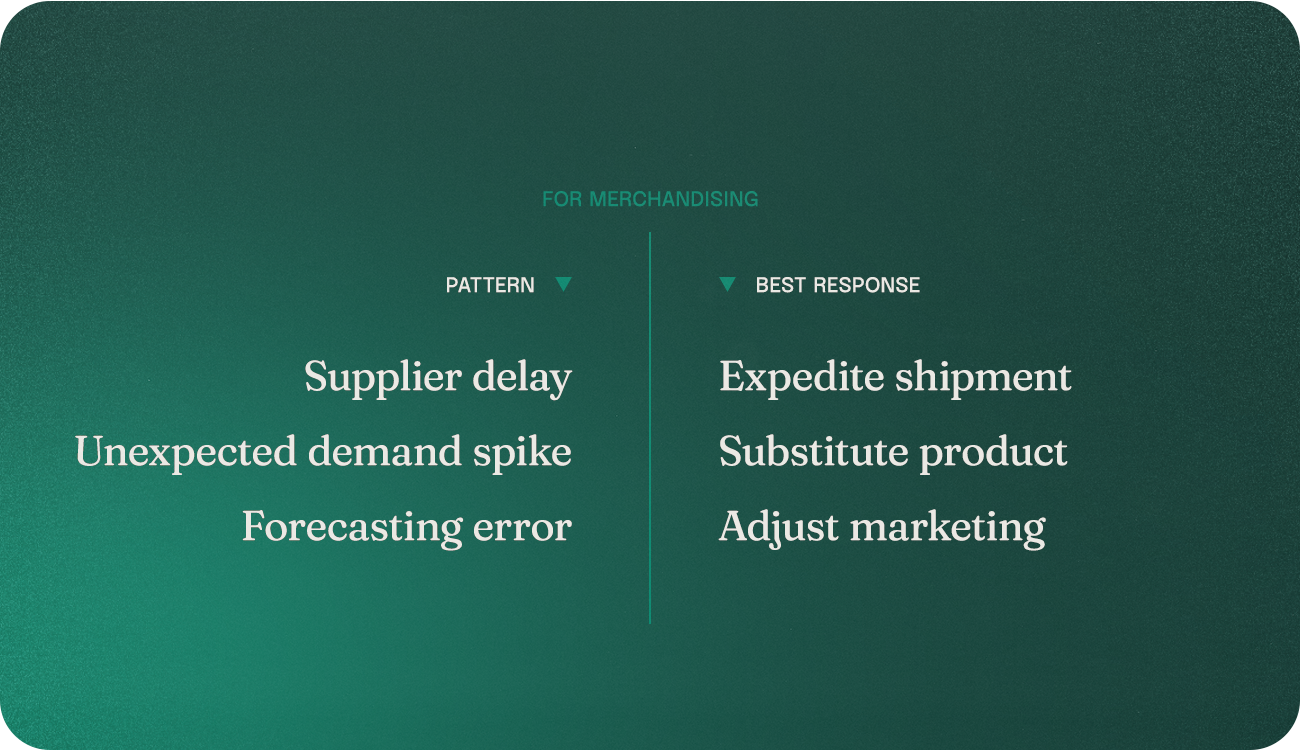
For merchandising: Instead of manually reviewing every out-of-stock situation, an AI agent identifies the pattern, determines the best response, and executes.
Pattern
Supplier delay, unexpected demand spike, forecasting error
Best response
Expedite shipment, substitute product, adjust marketing
You set the parameters–acceptable costs, brand implications, and customer impact thresholds–and the agent operates within them.
.png)
For customer experience: Rather than pre-scripted chatbots that frustrate customers into demanding human agents, agentic systems understand context, access complete customer history, and resolve complex issues. They know:
- When to escalate
- When to offer compensation
- When a customer's frustration level requires a human touch
Google's Business Agent feature that launched with Lowe's, Michael's, Poshmark, and Reebok puts branded AI assistants directly in Search results, acting as virtual sales associates. Customers get answers in your brand's voice without leaving Google.
.png)
For operations: Make decisions dynamically across your entire supply chain from warehouse allocation to last-mile delivery routing. Optimize not for a single metric but for the business outcomes you actually care about—margin, customer satisfaction, inventory turn, and sustainability targets.
This promise is compelling. And the execution is where most organizations stumble.
The problem nobody's talking about
Here's what Google's UCP announcement really means: Shoppers can now research products, compare options, and complete purchases entirely within Google AI Mode or Gemini without ever visiting your website.
You still get the sale. Google Pay processes it, you remain the seller of record, you fulfill the order. But you lose the site visit, the browsing behavior data, the cross-sell opportunity, the relationship touchpoint that informs everything from inventory planning to product development.
If you don't participate in protocols like UCP, your products may be harder to surface when customers expect a frictionless checkout. If you do participate, you're giving up control of customer data and relationship touchpoints that drive competitive advantage. Tech platforms want to own the shopping experience themselves to build sustainable platforms.
The strategic tension nobody's addressing head-on is that retailers need direct customer relationships to build sustainable businesses.
Ultimately, this isn't a technology decision. It's a strategic choice about where you compete and how you differentiate.
MERGE is addressing this tension, helping our clients make the best possible decision for their business. It’s where the Decision Science function (an interdisciplinary field that uses data to improve decision-making) becomes mission critical.
The Decision Science approach
Here's what we see happening: Retailers implement agentic AI, give it decision-making authority, and then realize they have no idea if it's making good decisions or just different ones.
You're delegating decisions that used to require human judgment. How do you know the AI agent is optimizing for the right outcomes? How do you identify when it's drifting toward unintended behaviors? How do you improve its performance when traditional A/B testing doesn't apply?
And now, with platforms like Google enabling customers to complete entire journeys inside their ecosystem, you're making these decisions with incomplete data. The customer bought from you, but you don't know what else they considered, what questions they asked, or what nearly changed their mind.
This is fundamentally a process and measurement challenge, not just a technology implementation. MERGE’s Decision Science practice exists specifically for this gap between what technology can do and what organizations need to make it actually work.
We start with decision mapping. Before implementing any agentic system or participating in platforms like UCP, we identify which decisions you're delegating, what outcomes matter, and what could go wrong. This isn't technology due diligence. It's business strategy translated into operational parameters.
We design evaluation frameworks. We ask questions like, “How do you measure whether an AI agent is making good decisions at scale?” We build the experimental infrastructure to test, monitor, and improve agent performance. Not just to illustrate if revenue went up but to truly see if the agent is reasoning correctly, optimizing for the right tradeoffs, and handling edge cases appropriately.
We have discovered through our work that organizations need frameworks for:
- Defining decision boundaries. What authority does the agent have? Under what conditions must it escalate? How do you encode brand values and business strategy into operational parameters when the transaction happens outside your direct control?
- Evaluating agent performance. Traditional metrics like conversion rate, AOV, and customer satisfaction tell you outcomes, not whether the AI's reasoning was sound. You need to understand why it made specific decisions and whether those patterns align with your strategic intent.
- Strategic participation choices. Which customer touchpoints remain on your property versus delegated to AI agents? Google's new Merchant Center attributes enable discovery in conversational commerce, but what product information do you provide versus withhold?
- Continuous improvement. How do you design experiments that improve agent decision-making when you don't control the full customer experience? How do you identify edge cases where human judgment should override automation?
- Merchandising decisions. Your team shifts from executing tasks to designing systems and evaluating performance, which means different skills, incentives, and success metrics. Google announced Direct Offers where advertisers can now present exclusive discounts directly in AI Mode. Who decides what offers to make or what margins you’re willing to sacrifice?
The real competitive advantage
The retailers who win with agentic AI won't be the ones who implement it first. They'll be the ones who implement it right. Doing it “right” means doing it with clear decision frameworks, robust evaluation, and organizational alignment.
At MERGE, we work with clients to create that alignment—defining maturity standards, identifying skill gaps, and building the data pathways that make information actionable for humans and AI agents. We also understand not everything should be automated.
We help identify where you must maintain human judgment and use AI to elevate these uniquely human abilities. For health and wellness retailers, there are regulatory considerations, duty-of-care obligations, and trust factors that shouldn't be delegated to generic AI agents. Our frameworks help you draw those lines clearly.
Google's announcement makes this strategic investment more urgent, not less. The technology will get cheaper and more accessible, but participating in agentic commerce ecosystems while protecting your differentiation is the sustainable advantage.
Agentic AI doesn't make better decisions by default. It makes the decisions you've designed it to make, optimized against the outcomes you've defined, within the boundaries you've set.
Want to talk through what this means for your organization?
Let's Talk.


